

From perfect prompts to powerful context: The marketing evolution you can’t ignore
AI is everywhere in marketing. You’re probably using it daily, drafting emails, brainstorming campaign ideas, analyzing performance data. And if you’re like most marketers, you’ve gotten pretty good at writing prompts that actually work.
But here’s what’s happening behind the scenes: while everyone’s been obsessing over the perfect prompt, a more fundamental shift has been quietly taking place. The marketers pulling ahead aren’t just better at asking; they’re better at giving AI everything it needs to succeed.
Welcome to context engineering. And if you can write a great brief, you’re already halfway there.
The problem with perfect prompts
Let’s start with what you already know. Prompt engineering (writing clear, targeted instructions that guide AI toward specific outputs) has been the star of the show. Think of it like giving AI a job to do, with precision and intention.
You’ve moved beyond “write a blog post” to “Write a 500-word intro for a B2B SaaS audience in a confident, expert tone that addresses the challenge of customer churn.” That’s solid prompt engineering.
But even your best prompts can fall flat if the AI doesn’t have the right foundation. It’s like giving a freelancer one perfect task without any brand guidelines, audience research, or examples of what good looks like.
This is where most marketing teams hit a wall. They craft brilliant individual prompts but find themselves constantly re-explaining context, editing outputs that miss the mark, or getting inconsistent results across team members.
The limitation isn’t in your prompting skills. It’s in the approach itself.
What context engineering actually means
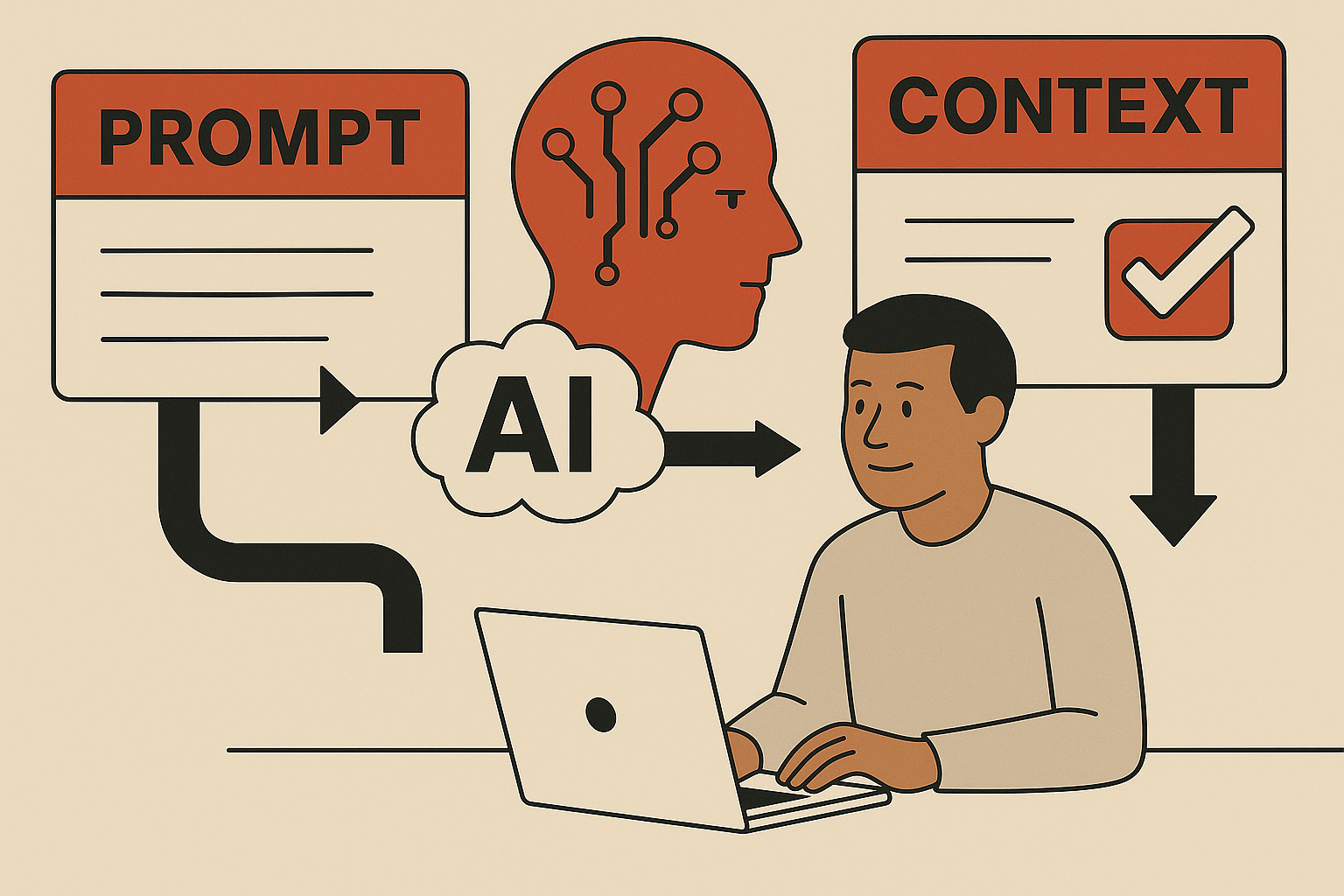
Context engineering is about shaping what AI knows before it starts generating anything. It’s the foundation that makes prompts work.
Think of it this way: the prompt is the question, context is everything the AI brings to the table to answer it. That includes brand voice, product positioning, customer insights, competitive intelligence, and performance history.
Marketers already work this way. You’re used to stitching together brand guidelines, sales intelligence, personas, and tone into comprehensive briefs. Context engineering is simply extending that same skill to AI.
Here’s what a strong marketing context stack looks like:
- Sales conversations and call transcripts as context goldmines
- Content libraries, brand guidelines, and campaign histories for consistency
- Customer artifacts and behavioral data for relevance
- Pipeline insights and competitive intelligence for strategic accuracy
- Performance data and attribution insights for optimization
When structured correctly, these sources can be embedded in prompts, added to system instructions, or loaded into tools as persistent background knowledge. The result: faster, more accurate, more brand-aligned outputs that actually sound like they came from your team.
How they work together (and why both matter)
Here’s the key insight: prompt and context are partners, not competitors.
The prompt tells AI what you want it to do. The context tells it how to do it. A request like “Create a competitive battle card” can lead to wildly different results depending on the context: your industry position, target audience, recent competitor moves, and sales team feedback.
The evolution in practice
Stage 1: Basic prompting “Write a product announcement for our new analytics feature.” Result: Generic, one-size-fits-all copy
Stage 2: Advanced prompting
“Write a 200-word product announcement for mid-market operations leaders, highlighting time savings and ROI, in an enthusiastic but professional tone.” Result: Much better, but still feels templated
Stage 3: Context-driven prompting AI has access to customer research showing operations leaders’ top pain points, competitor analysis of similar feature launches, your brand voice guidelines, and performance data from past announcements.
Simple prompt: “Create our Q2 feature announcement leveraging our style guidelines, past feature announcements, and voice of customer.” Result: Highly relevant copy that addresses real customer needs, differentiates against specific competitors, and uses language that actually converts
Real marketing applications that work
Let’s get tactical. Here are five scenarios where context engineering transforms your marketing workflow:
1. Sales enablement that sales actually uses
The challenge: Battle cards and sales collateral that sit unused because they don’t address real objections or use language that resonates.
The context engineering solution: Feed AI your recent lost-deal analysis, competitor intelligence, customer success stories by use case, and actual sales call transcripts.
Prompt: “Create objection-handling talking points for the pricing conversation.”
Result: Battle cards that use real customer language, address actual objections with proven responses, and include specific proof points that move deals forward.
2. Content that connects with real audiences
The challenge: Blog posts and thought leadership that sound authoritative but don’t drive engagement or conversions.
The context engineering solution: Load AI with customer interview transcripts, support ticket themes, sales questions, and your highest-performing content by topic and audience.
Prompt: “Develop a pillar content piece on data governance for enterprise buyers.”
Result: Content that uses actual customer language, addresses real pain points in their words, and includes examples and proof points that resonate because they’re grounded in real customer experiences.
3. Campaign optimization with strategic context
The challenge: Performance analysis that focuses on metrics without understanding the business context behind the numbers.
The context engineering solution: Provide AI with campaign objectives, audience segmentation data, seasonal trends, competitive landscape changes, and attribution models.
Prompt: “Analyze our Q1 email performance and recommend optimizations for Q2.”
Result: Insights that consider business goals, market dynamics, and cross-channel impact, not just open rates and click-throughs.
4. Personalized account-based content
The challenge: “Personalized” content that feels templated because it lacks genuine account intelligence.
The context engineering solution: Connect AI to CRM data, account research, industry-specific pain points, and competitive positioning by vertical.
Prompt: “Create a case study email for our logistics prospect.”
Result: Highly relevant content that speaks to specific industry challenges, uses appropriate proof points, and includes ROI calculations that matter to that particular vertical.
5. Voice of customer integration
The challenge: Messaging that sounds good internally but doesn’t reflect how customers actually talk about problems and solutions.
The context engineering solution: Feed AI customer interview transcripts, review site feedback, support conversations, and sales call summaries.
Prompt: “Refine our homepage messaging to better reflect customer priorities.”
Result: Copy that uses customer language, addresses problems in the way customers actually experience them, and highlights benefits customers care about most.
Your practical implementation guide
Ready to move beyond perfect prompts? Here’s how to build your context engineering practice:
Step 1: Audit your context assets
What you already have:
- Brand guidelines and messaging frameworks
- Customer research and personas
- Campaign performance data
- Sales team insights and call recordings
- Competitive intelligence
- Content libraries and templates
What might be missing:
- Recent customer feedback synthesis
- Cross-channel performance attribution
- Competitive messaging analysis
- Voice of customer documentation
Step 2: Structure for AI consumption
Create modular context blocks:
- Brand foundation: Voice, tone, positioning, messaging hierarchy
- Audience intelligence: Personas, pain points, decision criteria, objections
- Competitive landscape: Key players, positioning, messaging, strengths/weaknesses
- Performance insights: What works, what doesn’t, seasonal trends, channel effectiveness
- Market context: Industry trends, regulatory changes, economic factors
Pro tip: Use AI to help build your context stack. Upload past campaigns and ask it to generate a tone of voice guide or messaging framework.
Step 3: Build your context system
Start simple: Use platform features like Claude Projects or ChatGPT Custom Instructions to create persistent context for common marketing tasks.
Get modular: Create reusable context blocks for tone, audience, and value propositions that you can mix and match across different campaigns and channels.
Scale strategically: Build a living brand document that includes mission, audience profiles, tone examples, common objections, and messaging priorities. Update it quarterly with new insights.
Step 4: Test and optimize
Measure what matters:
- Output quality and brand alignment
- Time saved on editing and revisions
- Consistency across team members
- Strategic accuracy of recommendations
Common pitfalls to avoid:
- Information overload (too much irrelevant context)
- Outdated information skewing results
- Missing critical business context
- Poor context organization
Why marketers are uniquely equipped for this
Here’s the secret: if you can write a great brief, you can be a great context engineer.
Marketers already translate abstract brand strategy into concrete messaging. You build personas, define tone, and write briefs that guide teams and campaigns. You’re used to stitching together disparate information sources into coherent strategic direction.
Context engineering is simply an extension of what you do best. Marketing briefs are a form of context engineering. So are nurture campaigns, voice guides, and brand messaging frameworks.
The marketers who recognize this connection first will have a fundamental advantage in AI-powered marketing. You’re not learning a completely new skill; you’re applying existing expertise to a new medium.
The strategic shift that changes everything
Context engineering represents a fundamental shift from using AI as a tool to working with AI as a collaborator. Instead of “using ChatGPT to write copy,” you have a marketing teammate that understands your business, customers, and competitive landscape.
This isn’t just about better outputs. It’s about building institutional knowledge that compounds over time. Every campaign, customer conversation, and competitive insight makes the entire system smarter for everyone on your team.
The companies winning with AI aren’t just prompting better; they’re building smarter systems with richer context.
Your prompts aren’t the limiting factor anymore. Your context is.
Getting started today
Context engineering might sound complex, but you can start simple:
- Pick one repetitive marketing task you do regularly (competitive battle cards, campaign briefs, content creation)
- Gather the context sources that inform that task when you do it manually
- Structure that context into a reusable format AI can access
- Test with simple prompts and iterate based on output quality
- Scale gradually to other tasks and team members
The marketing teams that figure out context engineering now will set the standard for AI-powered marketing for the next decade. The ones who don’t will keep wondering why their AI outputs always feel like they’re missing something crucial.
They usually are. And now you know how to give them what they need.
